- ERE Weekly
- Posts
- Phenom’s Agentic Vision Gets More Ambitious
Phenom’s Agentic Vision Gets More Ambitious
At IAMPHENOM, the company’s message shifted from how many agents it offers to how intelligently they can work together.

David Manaster
March 18, 2026
User conferences rarely surprise me.
The format is polished, the customer stories are carefully framed, and if you’ve been to enough of them, the formula wears thin.
Last year’s IAMPHENOM stood out.
At the time, the market was already full of companies pitching AI agents that could handle individual recruiting tasks. There were tools for sourcing, tools for screening, tools for scheduling, and tools for every aspect of the hiring workflow. Phenom’s vision felt more comprehensive. Instead of presenting agents as isolated features, the company unveiled 25 new agents at the same time, and showed what it looked like to systematize and productize virtually every aspect of talent acquisition.
I went into this year’s event wondering whether Phenom could still produce that same sense of possibility.
TL;DR: It could.
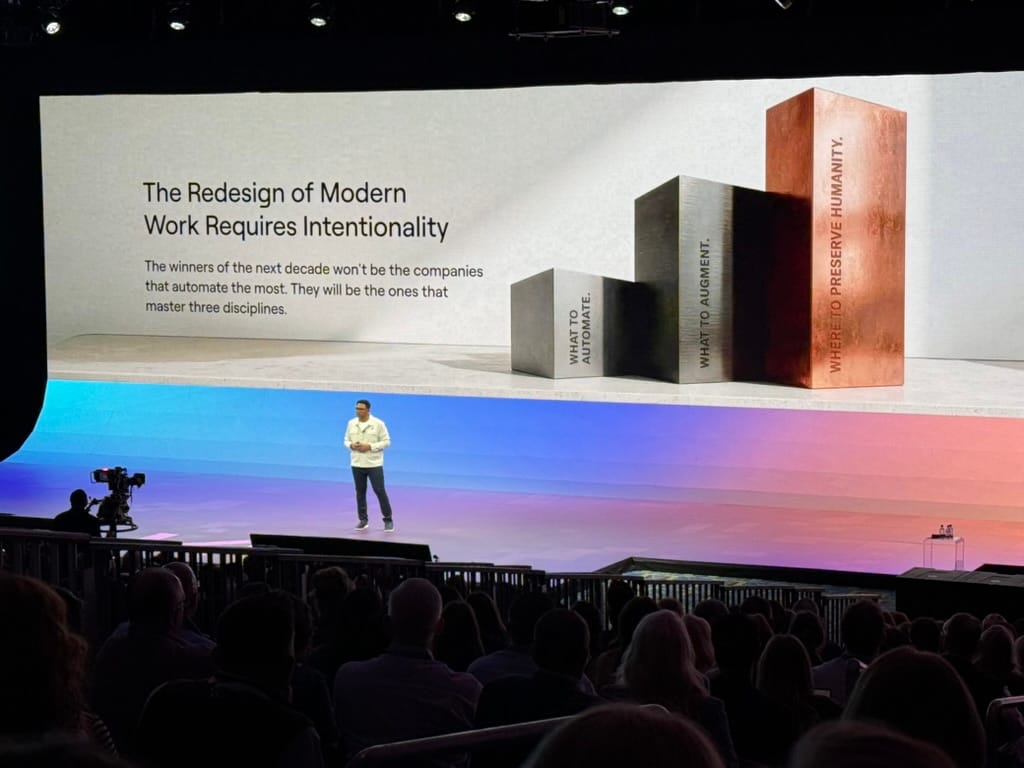
This year Phenom was no longer focused on touting the number of agents it offers. There are effectively an infinite number of unique agent possibilities because each agent is aware of context and local conditions. The emphasis now is on enabling talent acquisition teams to create customized groups of agents and coordinate them through what Phenom calls their “Orchestration Engine.”
In one of the more compelling demos, a Phenom employee gave verbal instructions to an agent and asked it to set up a program to recruit ICU nurses. After asking a few questions about the role and hiring context, the system went on to assemble a “symphony” of agents, spanning sourcing, scheduling, interviewing, and other steps in the process, then put the plan into motion. All of this from a single voice conversation.
Much of the conversation around AI in recruiting over the past year has centered on the idea that humans will orchestrate legions of agents that handle the repeatable work of hiring. In practice, many products still require so much manual setup, supervision, or task-by-task prompting that the larger vision remains just that: a vision. What Phenom showed, at least in demo form, was a level of self-direction that begins to make the orchestration model feel operational rather than merely conceptual.
Hiring a nurse in Dallas is not the same challenge as hiring a financial analyst in Dubai. The sourcing channels, labor market conditions, workflow requirements, and candidate expectations can all vary significantly.
When AI is expected to act with that level of nuance, context becomes the decisive factor. Phenom’s answer is the “hypercell,” which it says gives agents the contextual grounding they need to make educated decisions about how to structure themselves. In other words, the goal is not simply to automate tasks, but to make agent behavior responsive to the specifics of the role, geography, process, and organization.
Modern talent acquisition is complicated, and a bot that can do one thing well was never going to fundamentally change the profession. It was always going to be about whether AI could coordinate across an end-to-end hiring process in ways that reduce friction, adapt to local conditions, and execute against organizational goals. Phenom is pushing hard on that bigger idea.
The market is still catching up to the vision.
According to CEO Mahe Bayireddi, today only 20% of Phenom customers are deploying the agents correctly. The gap between what is possible and what is being utilized remains wide.
Nicole Mundy, Senior Analyst at Talent Tech Labs, put it this way: “As a front-end recruitment solution, Phenom is hard to match. They've created some very elegant programs for certain verticalized use cases that clearly generate ROI, but it's challenging for most organizations to get enterprise-wide value from the system. Those who can level up to what Phenom offers will have a competitive advantage, but it requires a deep commitment across many functions to really make it sing.”
That does not diminish what Phenom is showing. If anything, it makes the company’s positioning more consequential. Phenom is not simply marketing AI features. It is making a case for a different model of recruiting execution, one in which teams define objectives and set guardrails while coordinated agents carry out much of the operational work.
Phenom has a clear vision of the talent acquisition department of the future. Their challenge is helping organizations get there.
— David
P.S. If you found this newsletter valuable, chances are your colleagues will too. Feel free to forward it along—and if it landed in your inbox by way of a friend, you can subscribe here to get the next one directly.
Featured Story
AI Won’t Replace You. But It Will Expose You
Grant Wyatt frames AI less as a job killer and more as a mirror that exposes the quality of our thinking and standards. He contrasts low performers who use AI to avoid thinking with high performers who use it to pressure-test assumptions and sharpen judgment, then suggests a practical “exposure therapy” audit: map your role’s repeatable, rules-based work (easy to automate) and intentionally expand the human parts that remain, like accountability, ethical decision-making, and discernment. (ERE)
More Recruiting Insights
What was really behind Jack Dorsey laying off nearly half of Block’s staff? The Guardian reports that Block CEO Jack Dorsey blamed “AI productivity” for laying off about 4,000 employees, roughly 40% of the company, but the piece suggests the AI rationale may be covering for more traditional pressures like a weak crypto market, a falling stock price, and post-boom over-expansion. The narrative around AI taking knowledge worker jobs has been building for years (see the next insight), but so far it is not born out by the labor market numbers, and it’s much easier to blame a restructuring on AI and be rewarded by investors than to talk about the underlying weakness in your business. (The Guardian)
CEO of Glassdoor and Indeed parent says AI is not replacing workers: ‘We’re not seeing that kind of data at all’. Recruit Holdings CEO Hisayuki “Deko” Idekoba says the data from Indeed and Glassdoor does not support the idea that AI is already replacing workers, with only a small fraction of layoffs directly attributed to AI so far. (Fortune)
Vhinod Khosla disagrees. He expects AI to be capable of doing about 80% of today’s jobs starting around 2030, and he forecasts a deflationary shock as AI and robotics drive the cost of many goods and services toward “near free.” (Fortune)
Littler’s Workplace Policy Institute Survey Report. Littler’s 2026 Workplace Policy Institute survey of 306 in-house lawyers, HR leaders, and executives finds the biggest policy shocks for employers came from DEI (71%) and immigration (65%), with 63% saying immigration policies created staffing challenges. Regulatory and economic uncertainty is already translating into workforce actions, with 35% reporting workforce reductions and 30% pausing or reducing hiring. (Littler)
The Worst Jobs Report Since The Pandemic. Andrew Flowers breaks down a grim February 2026 jobs report showing 92,000 jobs lost, and notes the weakness persists even after stripping out distortions like the 10,000 federal job drop tied to a partial shutdown. Excluding healthcare, private employment still fell 58,000, with declines across construction, leisure and hospitality, manufacturing, and professional services, plus 69,000 in downward revisions to prior months. (Recruitonomics)
Matt Schwarzer Leaves OpenAI for Anthropic. In the last ERE Weekly, I wrote that Anthropic’s decision to publicly advocate for responsible use of their products by the US government would have profound impact of their employer brand. Note the callout to “values” at the end. (Matt Schwarzer)
How LinkedIn Is Improving the Feed to Show More Relevant, Authentic Professional Content. I’ve been saying for a while now that LinkedIn needs to stop optimizing for engagement and do a better job promoting the best information on the network. I hope this does it. (LinkedIn)
Workday takes partial loss as judge refuses to dismiss claims in AI bias lawsuit. A federal judge handed Workday a partial loss in Mobley v. Workday, refusing to toss the plaintiffs’ disparate-impact claims under the Age Discrimination in Employment Act and rejecting Workday’s argument that the law does not cover job applicants. (HR Dive)
Juicebox raises $80 million. CEO David Paffenholz announced the company raised an $80M Series B at an $850M valuation, led by DST Global with participation from Sequoia Capital, NFDG, Verified Capital, and Y Combinator. Paffenholz also shared traction metrics, including 5,000+ customers, tripled ARR, 3M+ candidates engaged, and 500,000+ searches, and has plans to accelerate product development, expand enterprise go-to-market, and open a London office. (Juicebox)
Elly raises $8 million. Elly announced its official launch alongside an $8M raise led by Sorenson Capital, with participation from Atomic and Next Wave NYC. The company is positioned as an AI-native hiring platform that unifies sourcing, interviews, and applicant tracking so teams can capture the context of hiring decisions in real time. (Elly)
ICIMS Unveils New Brand Identity. ICIMS unveiled a new brand identity positioned around “responsible AI” in enterprise recruiting, including a new tagline (“powering exceptional hiring”), and a renamed AI layer called ICIMS Coalesce AI. (ICIMS)
Conferences
ERE Recruiting Innovation Summit
Atlanta, GA
May 5-6, 2025
The ERE Recruiting Innovation Summit is a practitioner-led event built for talent acquisition leaders who want real answers, not hype. Now that the updated agenda is live, this is your chance to explore the sessions, speakers, and conversations shaping the future of recruiting.
Join us for practical sessions, meaningful peer connection, and live Ask Me Anything office hours with speakers. If you care about where recruiting is headed and want ideas you can put to work immediately, you belong in this room.
Webinars
Prevent Workplace Threats with Modern Screening
March 24, 2026 | 2:00 PM EST | 1 Hour
Traditional risk models were built for a different era, and high-risk warnings can show up online long before a traditional background check flags anything. Hung Lee and Fama CEO Ben Mones will share findings from Fama’s new State of Misconduct at Work and outline a simple, compliant screening roadmap focused on where modern threats surface first, why legacy checks miss them, and how to modernize without breaking FCRA and EEOC rules. (ERE)
Outbound is Back: How Lean Teams Win Without Burning Out
March 25, 2026 | 2:00 PM EST | 1 Hour
We will walk through a repeatable outbound system for lean recruiting teams: build strong lists, use real signals to prioritize who to contact, write relevant messaging, and run a cadence that stays consistent without overwhelming candidates. We’ll also cover guardrails like deliverability basics and frequency caps to protect employer brand, plus what you should be measuring to succeed. (ERE)
Detecting and Defending Against Candidate Misrepresentation
March 26, 2026 | 2:00 PM EST | 1 Hour
In this webinar we will tackle the rise of fake applicants, from AI-generated resumes and deepfake interviews to third-party test takers. We’ll cover practical tactics such as screening “traps,” interviewer training, verification tools for technical and non-technical roles, and legally defensible documentation. (ERE)