- ERE Weekly
- Posts
- Tinder Is the New LinkedIn
Tinder Is the New LinkedIn
What does it mean for recruiting when job-seekers blur lines between professional and dating platforms?

Vadim Liberman
April 08, 2026
What’s easier than landing a date on Tinder? Landing a job — at least according to Samantha Rogers, who says she scored three interviews via the dating app. Sure, Rogers scoured LinkedIn, Indeed, and the usual outlets to chase her next role, but it wasn’t until she wrote “seeking work opportunities” on her Tinder profile that employment prospects began percolating.
“It got me in the door quite quickly for interviews,” Rogers told Fortune.
The job she ultimately accepted wasn’t a result of Tinder. Still, Rogers evangelizes using dating apps for professional networking, explaining that the job market is “obviously a very crowded marketplace and there’s so many new emerging channels all the time that may be untapped.”
Which begs the question: Are Tinder, Bumble, and other dating apps the new LinkedIn?
Judging by the tally of articles on this topic in recent times, it’s easy to believe that countless job seekers are flocking to such apps to swipe for work. But should you believe that? And if so, should you start swiping on Bumble to connect with candidates?
First off, let’s touch on the reverse — that is, people increasingly exploiting LinkedIn for romance vulgarity. Ninety-one percent of women on the site report receiving inappropriate sexual messages. Rogers reveals she is one of them, recalling that “I had received multiple flirty messages by men on apps and platforms intended for anything but that. So I thought I would turn the tables on them and use the dating app as a platform for job seeking.”
It’s as if there’s a trend to “personalize” LinkedIn and “professionalize” dating apps in ways that obscure lines between the two. While the former trend feels true, I remain skeptical of the professionalization of dating apps. But before my eyes complete their roll, let’s look at some recent research.
An oft-cited study by Resume Builder from late last year shows that 34% of users on dating apps are taking advantage of them for professional purposes. Furthermore, 1 in 10 say they joined such apps primarily for such reasons.
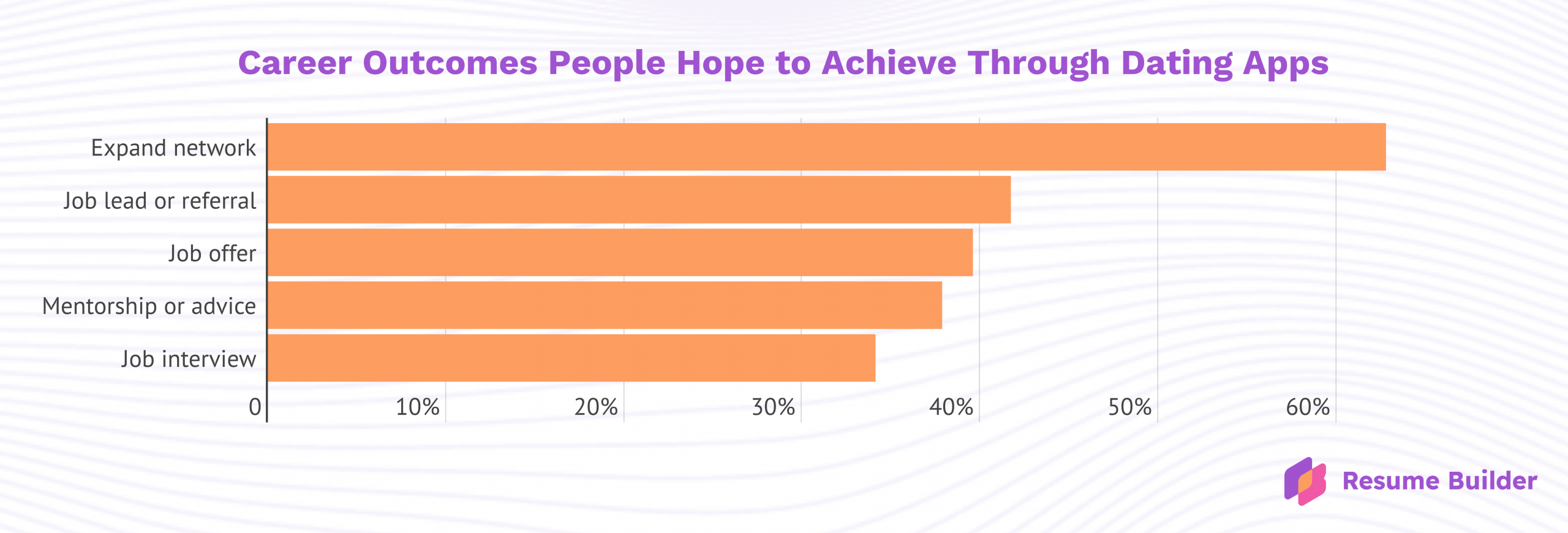
Resume Builder frequently promotes findings seemingly meant to produce virality. Its methodology is not exactly scientific and rigorous. We’re not talking Mercer white papers here.
But even if Resume Builder’s stats do not fully reflect reality, they nonetheless indicate that there is some contingent of job seekers taking an unconventional approach in an increasingly tight labor market.
“Traditional networking platforms, such as LinkedIn, can feel oversaturated and transactional, where everyone is pitching rather than genuinely connecting,” explains Resume Builder’s Chief Career Advisor Stacie Haller in a press release. “Dating apps, in contrast, provide a more personal and low-pressure environment for building authentic relationships.”
Meanwhile, George Arison, CEO of gay dating (ok, fine, more like hook-up) site Grindr, told The Wall Street Journal that 25% of its users are on the app to network professionally. “We encourage people to network on Grindr,” Arison admits.
“People are looking for any unique avenue to stand out,” says Mary Faulkner, former ERE strategy columnist and a principal with boutique advisory firm IA. “They are trying to find a job apart from the usual methods clogged by thousands of other individuals trying to find the same job. It speaks to the desperation that job seekers have right now.”
Faulkner is quick to point out, however, that we should not take a negative view of this. “The problem is the system, not the people,” she explains. “The economy is forcing job seekers to make choices that they probably would not have made two years ago.”
Google search stats seem to confirm this. Check out the chart below, which portrays a clear spike in searches connecting dating apps with work:

I wrote “seem” a moment ago because the cynic in me suspects that the rise in these searches stems from the broad coverage of Resume Builder’s recent survey.
Ultimately, the practical takeaway is definitely not that every TA pro should log on to Hinge to find their next hire. “The beauty of dating apps is that everyone is there presumably for the same reason — a relationship, a hookup, or something similar,” says Kate Bischoff, an employment attorney and regular legal contributor to ERE. “Once you start mixing motives, the potential for harassment skyrockets.”
Plus, Bischoff points out that a government body like the Office of Federal Contract Compliance Programs may look unfavorably at practices that include amassing candidates via apps like OKCupid. Throw in potential problems around discrimination, conflicts of interest, and favoritism, and Bischoff’s guidance is simple: “Stay off the dating apps for the purposes of recruiting.”
The real takeaway here is to improve your hiring process so that job-seekers do not feel compelled to head to dating sites in the first place. Make your application process more efficient. Ensure timely and accurate communication with applicants. Use tech in ways that respect individuals, not merely screen them out. (What a coincidence! There’s an amazing conference coming up to show you how to accomplish all this and more.)
Finally, when it comes to leveraging LinkedIn for romance, don’t. The site’s policy states that it is “a professional networking platform, not a dating site. Do not use LinkedIn to pursue romantic connections.”
Never mind that most true professionals on LinkedIn are interested in what happens in your boardroom, not your bedroom.
P.S. If you found this newsletter valuable, chances are your colleagues will too. Feel free to forward it along — and if it landed in your inbox by way of a friend, you can subscribe here to get the next one directly.
Sponsored Content
Most engineering hiring processes weren’t designed for how engineers work today.
AI is now part of how developers write code, debug systems, and solve problems. But many hiring platforms still evaluate candidates as if that shift never happened.
That creates a gap — and it’s costly.
A single bad engineering hire can cost over $75K in lost productivity, recruiting time, and team impact. Just as important, strong candidates can get filtered out by processes that don’t reflect real-world work.
To help teams close that gap, CoderPad put together a practical resource:
The Technical Hiring Platform Checklist for the AI Era
It includes:
Six core categories to evaluate any hiring platform
40+ specific features used by leading engineering teams
Key questions to ask vendors (including your current one)
A framework to align stakeholders on hiring decisions
This checklist is based on how some of the most advanced engineering organizations approach hiring today — including many from the Forbes AI 50.
If your team hasn’t revisited its hiring stack recently, it’s a useful place to start.
Featured Story
The Etch-A-Sketch Theory of Technology
If your company is like most, chances are you’ve invested a good chunk of money — again and again — in tech systems that continue to fall short of producing the outcomes you want. As Jason Pistulka asks, “If the technology keeps changing, why do the results stay the same?” The answer is because the problem is never the technology. It’s the design. Read about how it’s possible to boost the latter without entirely replacing the former. (ERE)
More Recruiting Insights
AI is powering a blue-collar hiring boom few saw coming. According to Randstad, since 2022 (when generative AI started becoming more affordable and accessible to businesses), the demand for many skilled-trade workers has more than doubled compared with the demand for knowledge employees. As this article points out, a main consequence has been that this has “allowed skilled blue-collar workers to flip decades of recruiting history by becoming the hottest ticket on the labor market.” After all, as Randstad points out, “AI can’t build data centers.” (Inc.)
The latest job gains are three times more than expected. U.S. employers added 178,000 jobs last month, while unemployment fell to 4.3%. However, that percentage conceals a tough truth: The drop in unemployment is partly because people working and looking for work decreased by 396,000 last month. Now for an even more sobering stat: The percentage of people in the labor force dropped to 61.9% last month, the lowest since November 2021. (AP)
Job-seekers are dropping serious cash to land job interviews. Some people are paying up to $2,500 — per month! — to “reverse recruitment” agencies. Essentially, these firms act as matchmakers, many guaranteeing a certain number of interviews within a given timeframe. And here I thought people are supposed to get paid for work, not pay to work. (CBS News)
No mediocre worker is safe as companies aim to fire then hire. There’s been a lot of talk lately about businesses pulling back on hiring, but this story points out that some organizations are actively hiring…after first firing employees. It’s almost as if Jack Welch wrote this article from the grave. (Business Insider)
Unilever imposes a global hiring freeze due to war in the Middle East. In an effort to cut costs, the consumer-products giant recently implemented a hiring freeze that it says will last at least three months. Notably, the company’s headcount of 96,000 is already down from 149,000 in 2020. Citing “macro economic and geopolitical realities, especially in the Middle East conflict,” the organization is especially struggling given that it’s share price has plummeted since early March. (Reuters)
The ever-elusive internship. Career-development site Handshake reported that in 2025, there were 109 applications per internship posting. As a result, the stress of finding work is hitting young talent before they enter the workforce officially. Anecdotally at least, it appears that employers are demanding more and more experience for internships. It’s the infamous catch-22: How does one get experience with no experience? (CNN)
Conferences
ERE Recruiting Innovation Summit
Atlanta, GA
May 5-6, 2026
The ERE Recruiting Innovation Summit is a practitioner-led event that brings together the leaders, ideas, and technologies shaping the next generation of talent acquisition. It’s an ideal opportunity to gain practical, real-world insights to address your most critical hiring challenges.
Join us for an interactive experience geared around community and connection, with sessions followed by speaker office hours for real-time Q&A, deeper discussion, and meaningful peer conversation among TA leaders.
Be a part of the future of talent acquisition next month. We hope to see you there! (ERE Recruiting Innovation Summit)