- ERE Weekly
- Posts
- What the Eightfold Lawsuit Means for Talent Acquisition
What the Eightfold Lawsuit Means for Talent Acquisition

David Manaster
January 28, 2026
While much of the US spent this week shoveling snow, talent acquisition got hit with its own kind of storm.
A class action lawsuit alleges that Eightfold AI’s platform secretly compiles detailed AI-generated evaluations of job applicants using personal and third-party data without informing candidates, and then uses those scores to screen and rank them — potentially violating the Fair Credit Reporting Act (FCRA) because candidates aren’t notified, aren’t given access to the reports, and can’t correct errors.
This is already having a more immediate effect than recent cases like Mobley v. Workday. As Sy Islam noted on ERE.net this morning (along with some practical suggestions for companies assessing their own exposure), there is no attempt here to prove bias or discrimination, which can be complicated. It’s a lot simpler — all they need to prove is that this kind of automated screening does in fact violate the FCRA. It’s a much lower bar to clear.
As Heather Bussing has pointed out in a must-read legal analysis of the case, many of the underlying compliance issues raised in the lawsuit will not be hard for the company to remedy. Candidates can expect new disclosures as part of their application process, not unlike the popups that became ubiquitous after GDPR. Also like GDPR, it probably will not change behavior in any meaningful way. Candidates need jobs, and for most this will just mean a few more annoying clicks. Those few who opt out will simply never be considered.
The consequences will extend beyond the courtroom, and beyond Eightfold itself. Legal concerns have always been a part of the due diligence process in selecting TA technology, but if we’re being honest, much of it has always been lip service. Now buyers are on notice that the legal threat is not just theoretical.
Every company in TA tech has spent the last few years building and marketing their AI hiring tools and platforms. Now they are rushing to show that they are not in the same boat as Eightfold. AI screening just got a little harder to sell.
Does the Eightfold lawsuit make you more cautious about using AI to screen candidates? |
Separately, LinkedIn released its January 2026 Labor Market Report, with interesting data on the broader hiring environment.
The data is drawn entirely from LinkedIn’s internal data, which is not representative of the global labor market as a whole. Still, LinkedIn sits on an enormous dataset, and the directional signals are worth paying attention to.
A few highlights stood out.
You are not imagining it — applicant volume has been steadily rising for over two years, while number of people who found jobs fell.

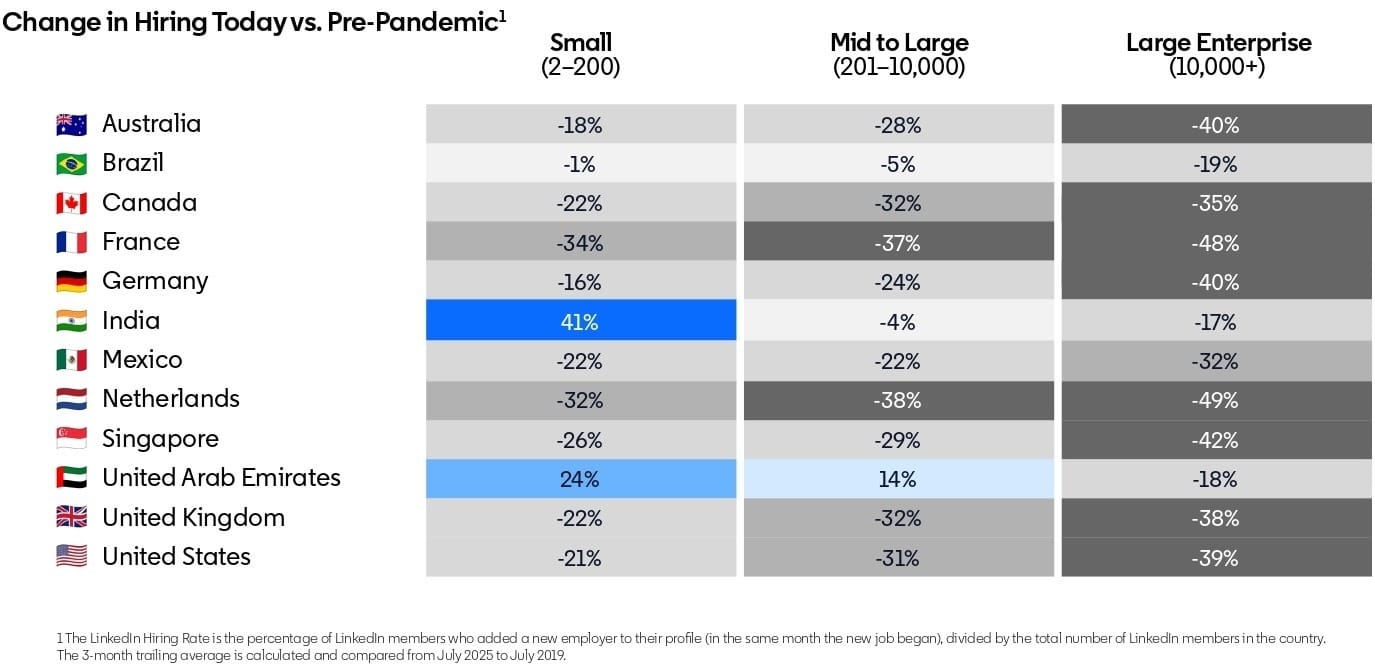
Businesses in most countries have decreased their hiring since 2019, but large enterprises have pulled back the most.
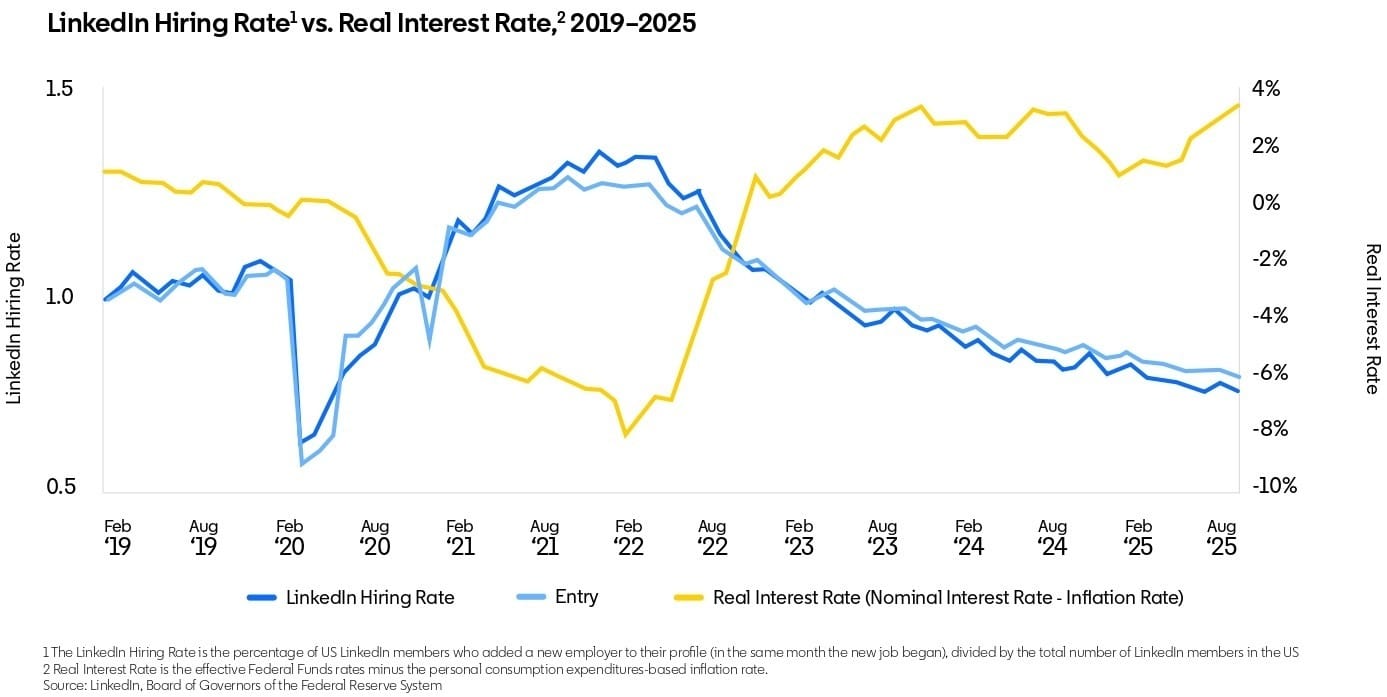
Despite widespread concern, LinkedIn is not seeing evidence that AI is driving the slowdown. They attribute most of the change to interest rates and the aftermath of the pandemic-era “great reshuffle.”

LinkedIn’s data shows that the hiring rate for entry-level positions is largely in line with more experienced roles, which is counter to the narrative that AI is destroying these jobs.
If you want to go deeper on all of this, we will be unpacking these issues and more at the ERE Recruiting Innovation Summit in Atlanta on May 5-6. From AI impact on the hiring process to tackling the challenges that rapid change brings to TA teams, these conversations will be front and center on the agenda.
I hope you will join us!
— David
P.S. If you found this newsletter valuable, chances are your colleagues will too. Feel free to forward it along—and if it landed in your inbox by way of a friend, you can subscribe here to get the next one directly.
Featured Story
The Next Expansion Won’t Fix Hiring
The LinkedIn data shows that hiring is getting harder. In this article, Raghav Singh argues the root cause is structural. We have a skill alignment problem, with fewer new workers from immigration, rising retirements, and chronic vacancies that keep roles open longer even as applications pile up. (Also, great news — Raghav will be joining us on stage in Atlanta at the ERE Recruiting Innovation Summit!) (ERE)
More Recruiting Insights
The great graduate job drought. In a sign of how confusing the current hiring situation is, the FT looks at NY Federal Reserve data and reaches a conclusion that is very different than LinkedIn’s. There is a “great graduate job drought,” leaving even strong grads struggling to get traction. Employers are pulling back on junior hiring amid uncertainty and AI-driven restructuring, which makes degrees less of a differentiator and keeps the market in a wait-and-see mode. (Financial Times)
More than a quarter of Britons say they fear losing jobs to AI in next five years. A Randstad survey finds 27% of UK workers fear losing their jobs to AI within five years, while 66% of employers invested in AI in the past year and over half of workers say companies are encouraging AI use. The piece highlights a mismatch between employer enthusiasm and worker anxiety, with Gen Z most concerned and job ads seeking “AI agent” skills up sharply. (The Guardian)
Why AI won’t wipe out white-collar jobs. The Economist argues that AI is unlikely to erase white-collar work because it automates tasks rather than whole jobs, which tends to expand roles and raise the value of human judgment. Productivity gains, reorganization, and new tasks are more probable than mass displacement, echoing past waves like spreadsheets that changed office work without wiping it out. (The Economist)
Conferences
ERE Recruiting Innovation Summit
Atlanta, GA
May 5-6, 2025
The ERE Recruiting Innovation Summit is a practitioner-led event built for talent acquisition leaders who want real answers, not hype. Join us for practical sessions, meaningful peer connection, and live “Ask Me Anything” office hours with our speakers.
If you care about where recruiting is headed and want ideas you can put to work immediately, you belong in this room.